Posted on

Hughes 1026496-0001 L-Band Distribution Switch: Clean Signal Routing for VSAT Systems

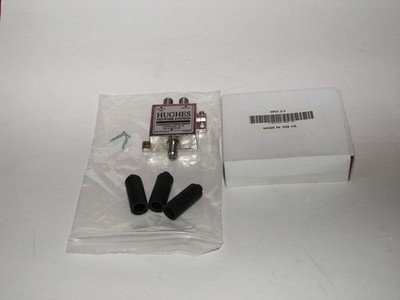
Lot of 2 HUGHES 1026496-0001 Digital Satellite L-Band Distribution Switch NEW

In a VSAT or digital satellite setup, getting the L-band signal from the outdoor unit to the right indoor equipment — without adding loss or letting the wrong device grab the line — takes more than a coax splitter.

Why L-band routing needs a dedicated switch

L-band signal coming down from a satellite dish’s LNB or BUC often needs to be directed to one of several possible destinations, or shared carefully between them, while keeping signal quality intact. A distribution switch handles that routing cleanly, so the connected receiver or modem gets a stable, correctly-routed signal instead of a degraded or ambiguous one.

What the Hughes 1026496-0001 actually does

The Hughes 1026496-0001 Digital Satellite L-Band Distribution Switch is a Hughes Network Systems 2×1 L-band switch built for digital satellite and VSAT ground systems, giving you a reliable way to route L-band signal between two inputs and a single output. This listing is a lot of 2, brand new, made in the UK, and comes with hardware.

Who it’s for

  • VSAT and digital satellite system installers
  • Anyone maintaining or expanding a Hughes satellite ground system
  • Buyers who need a spare or backup L-band switch on hand

Specs at a glance

  • Manufacturer: Hughes Network Systems
  • Part number: 1026496-0001
  • Configuration: 2 x 1 L-band distribution switch
  • Quantity: Lot of 2, new
  • Origin: Made in UK

Want more details or additional photos? See the full Hughes 1026496-0001 product page.

It’s on sale right nowgrab it here before the price goes back up.
Posted on

Channel Master 6602IFD 4×2 Multiswitch: Feed Two DIRECTV Receivers From One Dish

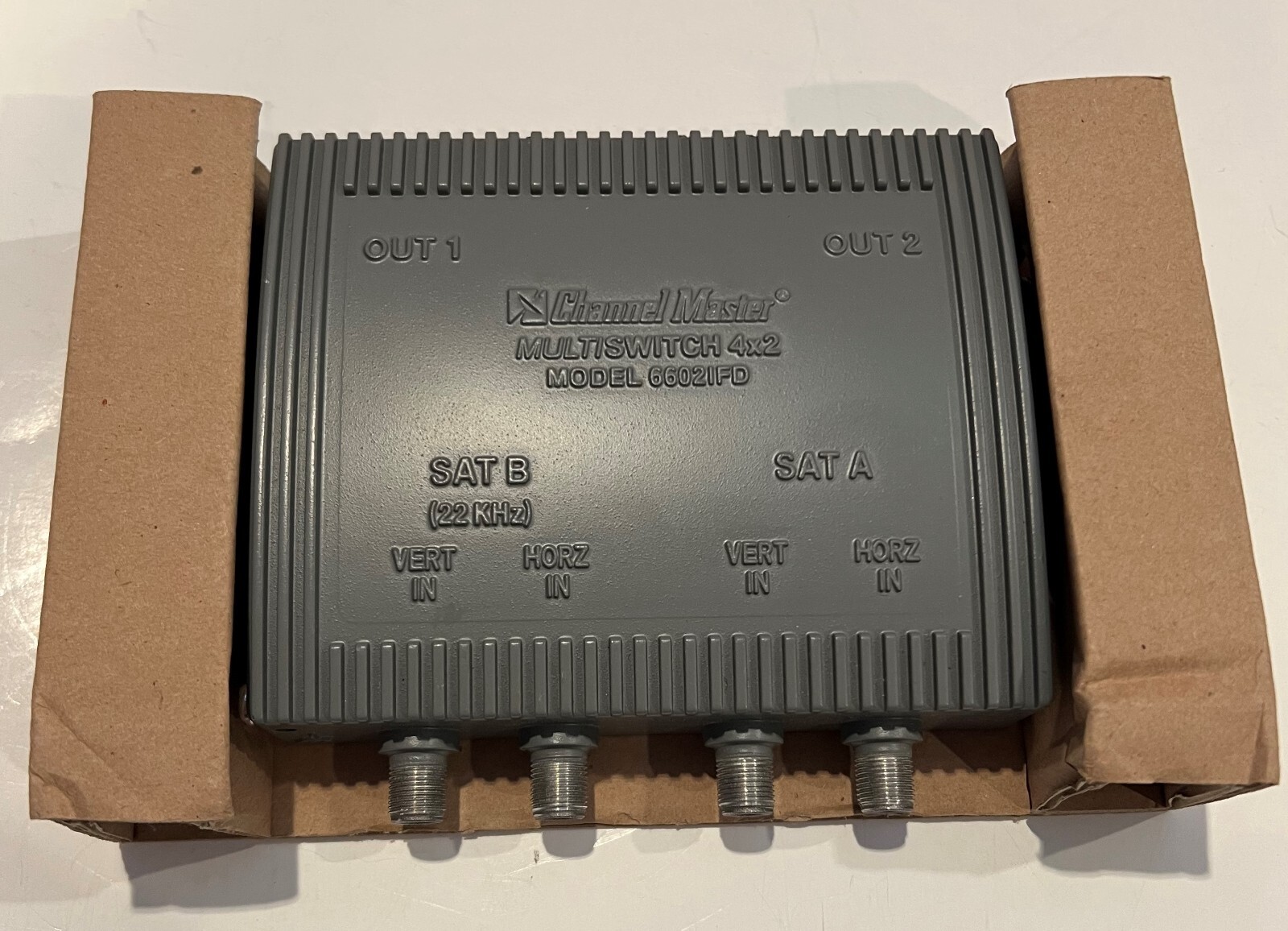
Channel Master Multi-Switch 4×2 6602IFD With Accessories

Running two DIRECTV receivers off a single dish means every satellite input has to reach both boxes without one receiver stepping on the other’s signal. A basic splitter can’t do that — you need a multiswitch.

Why one dish isn’t enough for two receivers

Standard DIRECTV dishes deliver multiple satellite feeds (LNBs) at once, and each receiver needs independent access to all of them to change channels or record. Splitting the signal with a plain coax splitter cuts signal strength and can cause tuning conflicts between receivers sharing the same line. A multiswitch solves this by taking in all the satellite feeds and routing a full, independent set to each output.

What the Channel Master 6602IFD actually does

The Channel Master 6602IFD Multi-Switch is a 4×2 DIRECTV-approved multiswitch: it accepts 4 satellite inputs from the dish and distributes them cleanly to 2 separate receiver outputs, so each receiver gets full, independent access to every channel without interference.

Who it’s for

  • Households running two DIRECTV receivers off one dish
  • Installers setting up or repairing multi-receiver DIRECTV systems
  • Anyone replacing a failed or outdated multiswitch

Specs at a glance

  • Configuration: 4×2 (4 satellite inputs, 2 receiver outputs)
  • Compatibility: DIRECTV approved
  • Included: Switch with accessories

Need the full picture, more photos, or pricing? Check out the Channel Master 6602IFD product page.

It’s on sale right nowgrab it here before the price goes back up.
Posted on

Pico Macom MX-7 7-Channel Mixer: Clean VHF Channel Separation for MATV Systems

New Pico Macom 7 Channel Mixer MX-7 Passive 7-Channel VHF Separator-Combiner

Feeding several channel-specific VHF antennas into one headend, or splitting one broadband VHF feed out into individual channels, sounds simple until you try it with ordinary splitters — cross-channel interference and harmonics creep in fast. A purpose-built mixing network is what actually keeps the signal clean.

Why combining or separating VHF channels gets messy

Ordinary splitters and combiners aren’t built to isolate individual VHF channels from each other. In a shared-antenna setup — an apartment building, hotel, or campus running MATV or SMATV — mixing several antenna feeds into one line with the wrong hardware introduces harmonics and cross-talk that show up as a noisy, unreliable picture on every set downstream. The fix is a low-loss network built specifically to separate or combine channels without adding that interference.

What the Pico Macom MX-7 actually does

The Pico Macom MX-7 is a passive, low-loss 7-channel VHF separator-combiner — an extremely cost-effective solution for smaller MATV and SMATV systems. It works both directions: used as a separator, it significantly reduces system harmonics when placed ahead of a series of Pico Macom’s XBS single-channel strip amplifiers or signal processors. Used as a combiner, it’s the ideal filtration system for merging outputs from channel-specific VHF antennas before they’re inserted into a cable system via Pico Macom’s TA52. The compact, user-friendly design makes installation straightforward, and individual channel tuning plus attenuator controls let you dial in setup or reconfigure quickly, cutting system downtime.

Who it’s for

  • MATV/SMATV system installers and operators — apartment buildings, hotels, campuses
  • Anyone combining multiple channel-specific VHF antennas into a single headend
  • Anyone separating a broadband VHF feed into individual channels for processing or amplification

Specs at a glance

  • Channels: 7
  • Type: Passive VHF separator-combiner
  • Frequency range: 54–216 MHz (VHF)
  • Impedance: 75 Ohm
  • Condition: Brand new

Full specs, photos, and current pricing are on the product page here.

It’s on sale right nowgrab the Pico Macom MX-7 here before the price goes back up.

Posted on

NAS BVS 3-01 CATV Signal Amplifier: Fix Weak Picture From Splitters

If every TV in your house looks a little washed out or pixelated the moment you split your cable line to feed more than one room, the amplifier isn’t optional — it’s the fix.

Why your picture gets worse after you split the line

A single coax run from the wall already loses a bit of signal over distance — roughly 6 dB per 100 feet on standard RG6 cable. Add a splitter and it gets worse: a basic 2-way splitter drops another 3.5–4 dB, and an 8-way splitter (common in multi-TV households) can cost you 14–15 dB. By the time a signal reaches a bedroom TV at the end of a long run through two or three splitters, there often isn’t enough of it left for a clean picture.

That’s a distribution problem, not a weak-antenna or interference problem — and it’s exactly what a line amplifier is built to solve.

What the NAS BVS 3-01 actually does

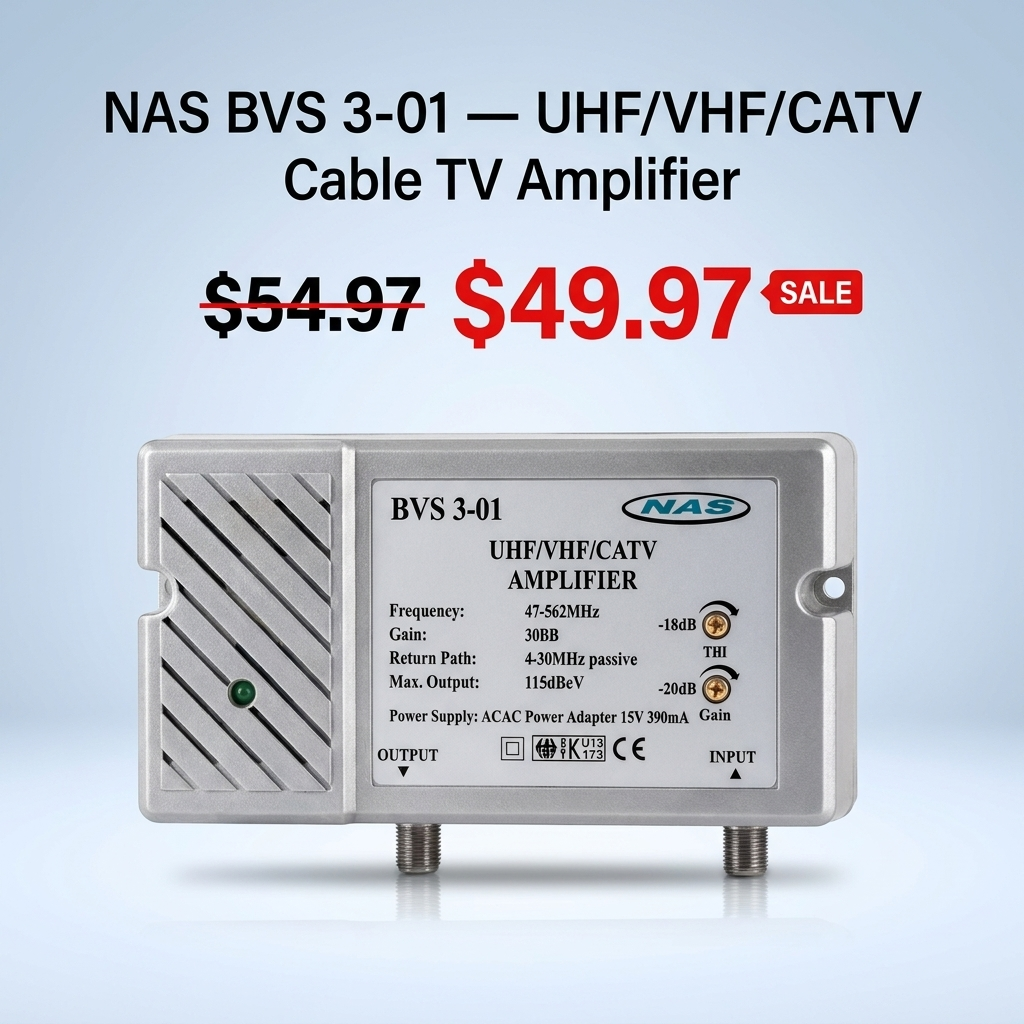
The NAS BVS 3-01 is a 30 dB UHF/VHF/CATV amplifier covering the full 47–862 MHz range — meaning it boosts both the VHF and UHF bands used by over-the-air broadcast channels as well as standard cable TV frequencies. Instead of replacing your splitters, it sits inline and restores the signal strength they take away, so every outlet downstream gets a clean, full-strength feed again.

Who it’s for

  • Homes with 3 or more TVs sharing one incoming cable line
  • Long cable runs to a garage, basement, or upstairs bedroom
  • Anyone who added a splitter after the fact and noticed the picture got worse

Specs at a glance

  • Gain: 30 dB
  • Frequency range: 47–862 MHz (full VHF + UHF + CATV)
  • Coverage: UHF, VHF, and CATV signal types

Full specs, photos, and current pricing are on the product page here.

It’s on sale right nowgrab the NAS BVS 3-01 here before the price goes back up.